Biblical Retirement, Charitable Giving, GIVMOAR Video, Taxes
How to Donate Appreciated Stock to Your Church (And Never Pay Tax on the Gain)

Jason Demland

Giving is awesome. It’s the most fun way to spend your money. The way you give matters quite a bit. What if you can give more without giving more? If you’re someone who is already regularly giving to your church or other charity, and you have saved well and have some healthy investment account balances – like a brokerage account with some accumulated capital gains in it – then strategically giving gifts of appreciated securities may be a way to maximize how much you give and how much the church gets, and minimize how much you pay in taxes. Maybe that sounds like a bunch of work, but the less you send to the IRS the more you have to give. Render unto Caesar and give.
Saving money into a taxable brokerage account is a great way to add flexibility to your retirement plan. These accounts are subject to different tax rules than your retirement accounts though. Gains and losses in a retirement account don’t really matter when it comes to taxes – those are before-tax or after-tax accounts that are taxed according to their own rules. The growth inside retirement accounts is usually protected from taxes – those are like special accounts wearing a bulletproof vest that keeps them safe from the machine-gun fire of the IRS while they grow. A taxable brokerage account is an investment account that has no special protection, and the growth inside those accounts is subject to capital gains tax. The tax on capital gains can work out to be favorable when compared to ordinary income, depending on your income level in the year they’re realized. An even better way to reduce capital gains taxes is to not realize them at all – and one way you can do that is by giving away the securities that have grown in value.
Rather than selling the positions and realizing capital gains and then giving the proceeds of the sale to your church or charity, you can donate the position directly and here’s why that’s a great idea: selling an appreciated security will result in a realized gain and that gain will increase your adjusted gross income, which raises the deductible floor for your giving and could impact Medicare surcharges and the senior deduction phase-out. Giving the shares doesn’t do any of that! If you itemize deductions, you could deduct the full value of the position you give and the church receives the entire value, while you and the church get to avoid paying taxes on the gains altogether. You give more, the church gets more, and the IRS gets nothing.
Let’s look at Hank and Peggy Hill – very fake and not real clients that I’ll use as a hypothetical illustration. Hank makes $250,000 a year and is in his last year of work. They have a total AGI of about $266,000 and they give $25,000 a year to their church. They watched a financial planner on YouTube say they should consider bunching their donations to take advantage of itemizing their deductions and they hold a position in their non-qualified investment portfolio worth about $79,800 (there’s a reason I picked this odd number) that they’re interested in giving to their church along with their regular annual gift this year. What’s the difference to them if they sell the position and give it away vs. if they give the shares? Both ways the church will receive the same $104,800. But if the Hills were to sell the shares first, they’d realize about $40,000 of gains which would push their AGI over $306,000 and cost them total federal taxes of about $32,735. If they gave the shares directly? Well, then they’d only be taxed $25,190 for the year – about seven and a half thousand dollars less for doing the same generous act in a different order.
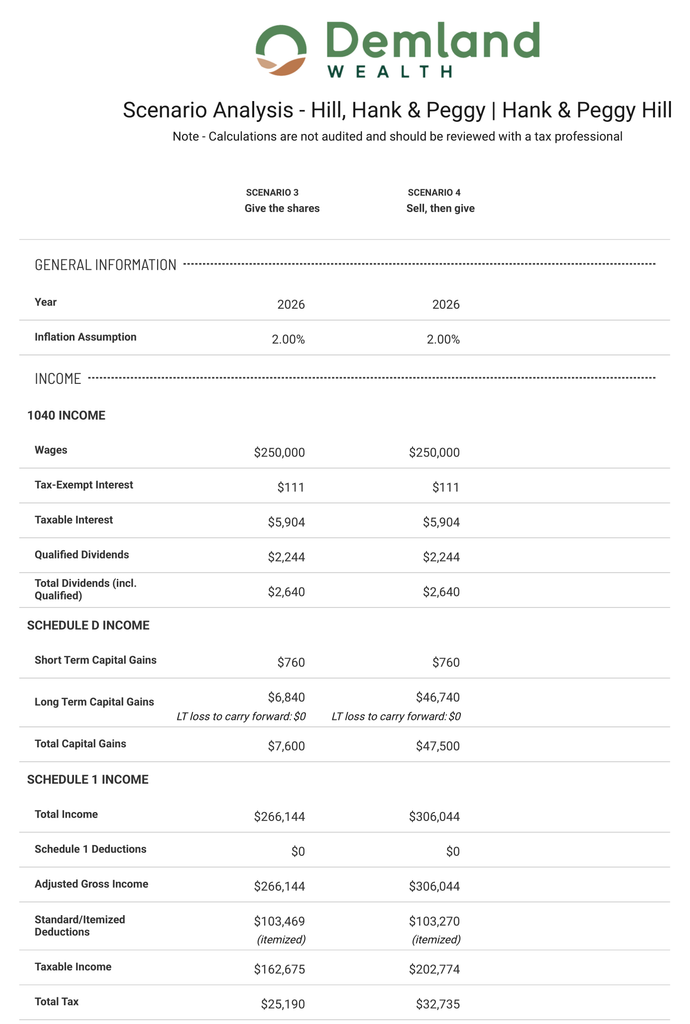
This $7,545 difference comes mostly from capital gains taxes paid at a 15% rate – which works out to about $6,000. There’s more net investment income tax as well that kicks in because of the realized gains. Once AGI for the Hills moved past $250,000 they were subject to a 3.8% rate on any net investment income over that threshold. And the additional $40,000 in gains cost them about $1,500 compared to their base scenario. The AGI 0.5% floor rose too as the realized capital gains increased their AGI, so that added an additional $44 in tax.
There are some rules and logistics to this that are pretty important. The position you give must count as “long-term,” which means you must have held it for more than a year. Otherwise it’s “short-term” and you only get to deduct the basis of the position – or how much you paid for it. The maximum you can deduct in the current year is limited to 30% of your adjusted gross income and you have to take the 0.5% of AGI floor off of your total giving for the year. Remember the oddly specific amount I used for the gift? The Hills’ gift of $79,800 is just under 30% of the Hills’ $266,000 AGI, sized so the whole gift gets deducted this year. And it must go to a public charity or donor-advised fund (your church almost definitely qualifies since churches are public charities by definition in the tax code). If you go over the 30% of AGI, don’t worry – your deduction isn’t lost, it gets carried forward for up to 5 subsequent tax years. If you’re gifting a publicly traded stock then it’s pretty simple – you’ll just need to file Form 8283 if it’s worth more than $500. For gifts of non-publicly traded securities, or things like a business interest, commodity, farm ground then there are more complicated rules for each of those – but they can all still be done!
This all means that you’ll want to identify a specific lot, which is a batch of shares bought at one time at one price, of a position that has a whole bunch of appreciation in it and specifically give your highest appreciated assets to get the most out of this transaction. If you own stock in a publicly traded company, or an ETF or mutual fund that you’ve owned for a long time and its value has grown far beyond what you put into it and it’s in a non-tax-qualified investment account then it’s a prime candidate for gifting. It doesn’t really make sense to donate a security that has lost value or something that you’ve owned for less than a year so I wouldn’t consider those. For it to count as a deduction in a given year, the transaction must occur in that year – because delivery date is the date that counts so if you’re considering this strategy don’t wait until Christmas to get it done.
It’s especially useful to use a donor-advised fund (which we talked about in a previous episode) to make gifts of appreciated securities. The donor-advised fund can receive gifts of appreciated securities rather easily when your church may not be able to. I was a church treasurer for quite a while, of a pretty small church, and while many churches have the infrastructure all set up to receive gifts of securities the reality is that most small ones don’t. When the church doesn’t have a brokerage account or full-on payroll or administrative staff, it’s much easier to receive gifts of cash. When you give to your donor-advised fund and then direct grants to your church, the church receives gifts of cash which are very simple to handle. Your church treasurer will thank you for making their life easier. And you don’t have to give your entire gift all at once either – you can replace weekly or monthly giving from your checking account with regularly scheduled grants from your donor-advised fund. This allows for one big gift of appreciated securities as a sort of “bunched” gift that allows for itemizing and taking a larger deduction than you may have taken throughout the year, or if your asset has appreciated significantly and you’d like to diversify out of it. You can give the appreciated lot to your DAF, rebalance the holdings into something else, and then regularly give to your church from the DAF. This is a great routing tool for giving appreciated securities to your church or any charity.
When giving a large appreciated asset either to your church directly or to a charity, you may also open up some more room to harvest capital gains on other securities you hold at a lower rate. I’m going to get technical for a minute so bear with me: The capital gains tax rate is tested AFTER deductions – so if your large gift of appreciated securities lowers your taxable income enough to enable you to realize more capital gains at a 0% or 15% capital gains rate, you may be unlocking even more tax savings. You could harvest gains and rebuy other securities and reset your basis and leave everything in the portfolio. You could donate lots with the most appreciation and then harvest lots with less appreciation. Realized capital gains will still increase your AGI, so you still need to watch out for Social Security benefits taxation, reduction of your senior deduction, NIIT, and impacting IRMAA (Medicare premium surcharges) 2 years after, and can take up space in your tax brackets you may want to use for Roth conversions. But this method can meaningfully reduce your federal tax rates. Combining all of these strategies together is where things get really complicated and fun, and need to be tailored to your portfolio, goals, and what’s overall qualitatively most important to you.
This strategy won’t work or be very useful to everyone. If you’re in a perpetually low-income bracket and that means under $98,900 of taxable income if you’re married filing jointly in 2026, then long-term gains are already taxed at a 0% rate federally. You’ll be served well by capital gains harvesting and rebalancing. Giving cash is simple here. If you only have long-term losses or short-term gains, then this doesn’t matter much either. If all you have is qualified retirement money, like a traditional IRA, then Qualified Charitable Distributions might be the best weapon for you to use if you’re already taking required minimum distributions. That’s an even more tax-efficient way to give than gifts of appreciated stock and the lowest hanging fruit in the Christian’s charitable giving toolkit. That’s what we’ll talk about next time.
You might be thinking that I’ve just turned your charitable giving into a math problem. I’m not trying to suck the joy out of giving here, quite the opposite! You’ve already decided in your heart what to give and that’s the most important part, but stewardship means exercising wisdom over all you’ve been entrusted with and that means your investments, your retirement plan, and yes, your taxes. Abraham Kuyper said there is not a square inch in the whole domain of our human existence over which Christ, who is Sovereign over all, does not cry: “Mine!” Those gains in your account belong to Christ. Handling them well is faithful and something to be celebrated. Do it for the glory of God.
Soli Deo Gloria!
Sources
- Abraham Kuyper, “Sphere Sovereignty” (1880), in Abraham Kuyper: A Centennial Reader, ed. James D. Bratt (Grand Rapids: Eerdmans, 1998), p. 488.
- IRS, Revenue Procedure 2025-32 (2026 inflation adjustments, including capital gains brackets): https://www.irs.gov/pub/irs-drop/rp-25-32.pdf
- Treas. Reg. §1.170A-1 (charitable contribution and delivery-date rules): https://www.law.cornell.edu/cfr/text/26/1.170A-1
- IRS Form 8283, Noncash Charitable Contributions: https://www.irs.gov/pub/irs-pdf/f8283.pdf
The example in this article is a hypothetical illustration, not a client. Projections are not guarantees of future results.
This content is for educational purposes only and is not intended as legal, tax, or investment advice. Please consult with a qualified professional for guidance specific to your situation. Investment advisory services offered through Demland Wealth LLC, a state-registered investment advisor in Ohio & Indiana.