Biblical Retirement, Charitable Giving, GIVMOAR Video, Taxes
The Donor-Advised Fund (and why the new tax law makes it necessary)

Jason Demland

The way charitable giving is taxed changed this year, and if you give faithfully to your church every month, that change did almost zero for you. You give regularly and our tax code allows you to deduct charitable gifts. Why are you getting the same deduction as folks that give little or nothing? How can you make sure you’re getting the biggest deduction possible without changing the amount of money you’re giving each month or year to your church? Well, if you have a money question or worry — the answer is probably GIVMOAR. I’m Jason Demland. Welcome to GIVMOAR.
The Problem
There is much to be grateful for in the United States of America, and one of those things is that our tax code encourages giving. In 2026 a married couple, both 65 or older, gets a $35,500 standard deduction right off the bat, without giving anything. If they give to a charity, they can get an additional $2,000 on top of that. There’s also an additional new $6,000 per-person senior deduction, but that doesn’t have anything to do with giving. So if you don’t itemize, it doesn’t really make a difference if you give $2,000 or $30,000 to your church. The deduction is the same. I think big standard deductions are great, but they can disincentivize charitable giving when you’d get the same deduction whether you give a lot or give a little. We’ve already talked a lot about how taxes shouldn’t direct your giving and that your church is the first place you ought to give, but that doesn’t mean we shouldn’t look for opportunities to maximize the tax benefits of our already planned giving. We should be looking for opportunities to give smarter.
Take Hank and Peggy here as an example with some hypothetical and projected figures. Hank and Peggy Hill are just about to retire. Hank is working his final year at work. They give $25,000 to their church every year, but you wouldn’t know it from their tax return. They’re getting a nice standard deduction according to this hypothetical example, and they only get to deduct an additional $2,000 because of their large annual gift to their church. Oh well, right? I don’t think so. What if you could go ahead and “pre-give,” say, about 5 years’ worth of your annual tithe, continue to give to your church monthly, and deduct that whole 5 years’ worth of giving in a single tax year?
The DAF
A donor-advised fund is exactly the vehicle for this job. You can make one large gift to the fund of cash or even appreciated stock, claim that deduction now, and grant it to your church over time. The bonus is that money can stay invested and compound as well, and may very well grow to even more later. The catch is that the money isn’t yours anymore — you’ve given it away and it must eventually go to a qualified charity. The good news is that sponsoring organizations of donor-advised funds are incentivized to make the grants you recommend. If they didn’t, then it’s likely that folks would stop using them and go somewhere else. I’ve successfully employed this strategy with clients and it might work for you too.
Bunching
The reason to use a donor-advised fund is to get a tax deduction you otherwise would not have gotten. If you bunch several years’ worth of giving into one large charitable gift to a DAF, then you’ve cleared the standard deduction and cleared the new 0.5% of AGI floor for deducting charitable gifts all at once in one year, instead of having to do that each year. Yeah, there’s a new 0.5% floor for charitable gift deductions that was included in the One Big Beautiful Bill Act. I’m not excited about it, and while it didn’t change anything about DAFs (it actually leaves them out of the new $2,000 deduction for gifts to charity), it did make this bunching strategy more necessary. While the Act added an additional $2,000 deduction for direct gifts to charity for folks taking the standard deduction, for itemizers it added this 0.5% floor — which reduces the amount you can deduct if you itemize.
The use case for this really depends on your income. If you have a high-income year because you’re still working, or because you’re doing Roth conversions, or because you’ve sold a business, that’s when this makes a lot of sense. Let’s look at Hank and Peggy Hill’s plan.
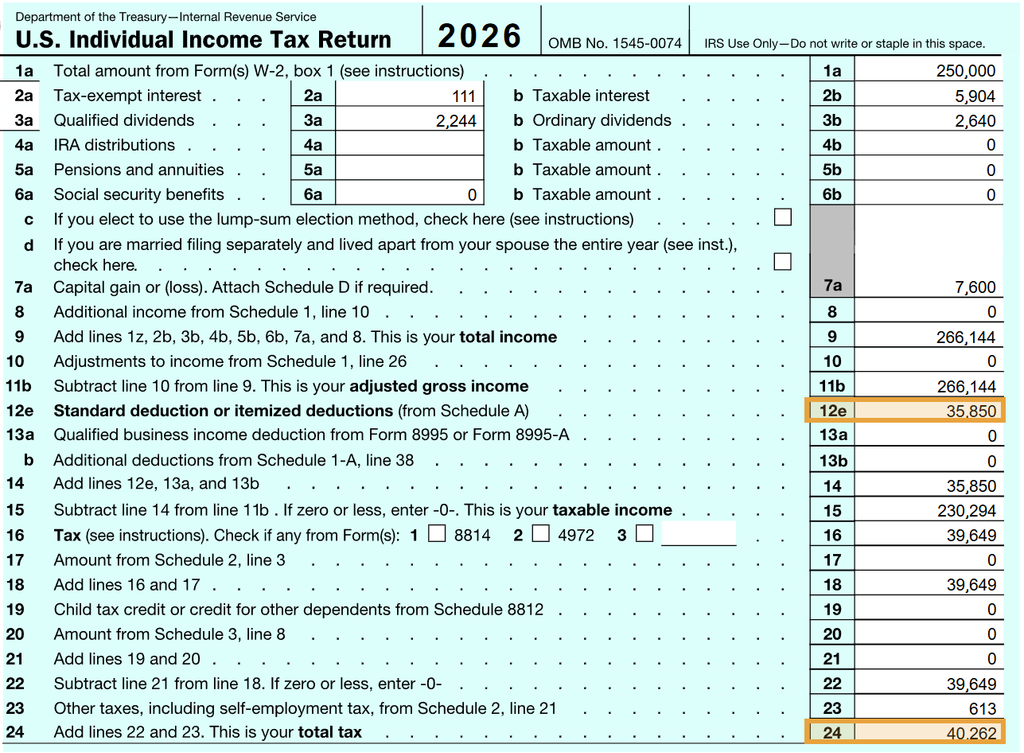
Hank is in his last year of work before retirement and will make $250,000 this year from his job and around $16,000 in additional interest, dividends, and capital gains from their investment accounts. Hank’s 66 and Peggy is 64, so Hank gets the senior add-on to the standard deduction. If they continue as normal they’ll pay $40,262 in federal taxes and use a standard deduction of $33,850 plus the $2,000 for their $25,000 in church giving. Now, Hank and Peggy have saved well and have enough cash and after-tax investment money to “pre-give” a substantial amount to their church through the conduit of a DAF without taking money from their IRAs.
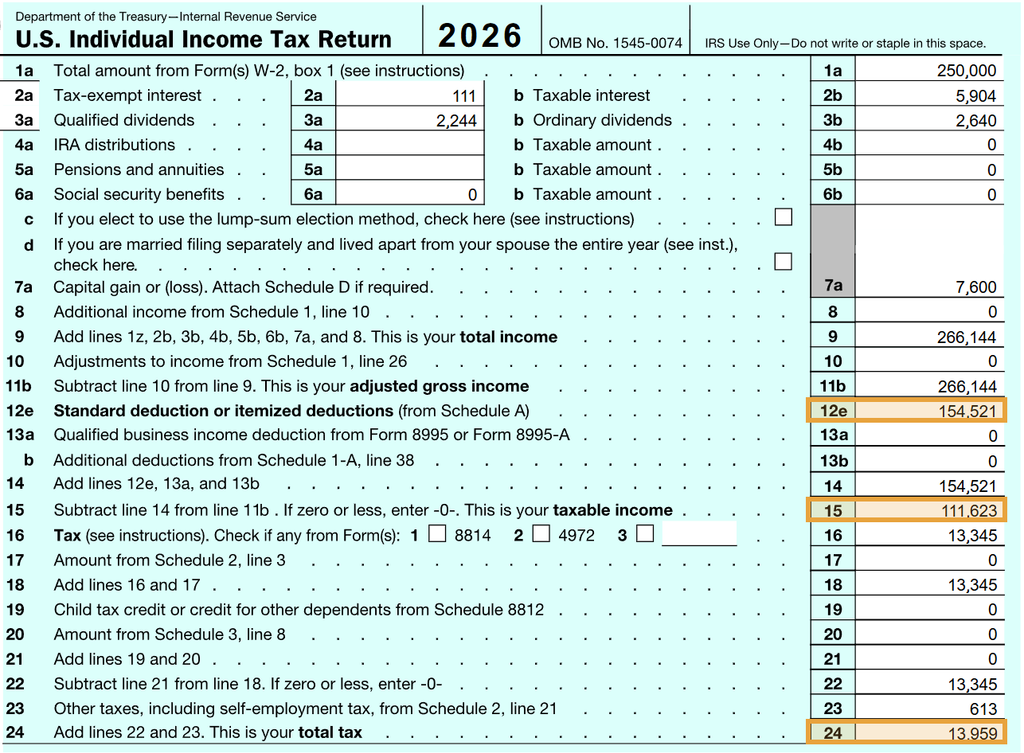
Let’s say they decide to donate six years’ worth of their annual giving — that works out to a $150,000 gift to their donor-advised fund — and instruct the DAF to grant $25,000 a year to their church for the next five years (I’ll come back to this). Now their total deductions come out to $154,521 and their taxable income is reduced to $111,623 in 2026. That reduces their total federal tax from $40,262 to $13,959 in the year. That’s a $26,303 difference in federal tax (a little more than one year’s worth of giving to their church!). Note that AGI is the same in both scenarios; the DAF just reduces taxable income.
The Plan Doesn’t Break
The pushback against this is parting with all of that cash right up front. “Won’t this break my plan or cause us to run out of money faster?” Well, that’s definitely something to check out and why a plan is really important. Luke 14:28 encourages us to count the cost. We ought to be wise, but don’t be afraid. Remember, fear says you can’t part with all that money right away, but what if the plan says you can? Fear overpays on taxes and gives little.
Look at Hank and Peggy’s plan. We’re comparing apples to apples here, and the only difference is a large gift to a DAF and replacing giving for a few years with grants from the DAF instead of from their savings, and later, when Hank is 71 years old, switching to qualified charitable distributions. The DAF proposed plan actually turns out better in the long run. Now, we don’t know exactly what will happen in your life, and that’s why planning is ongoing forever and this Monte Carlo analysis is just a projection.
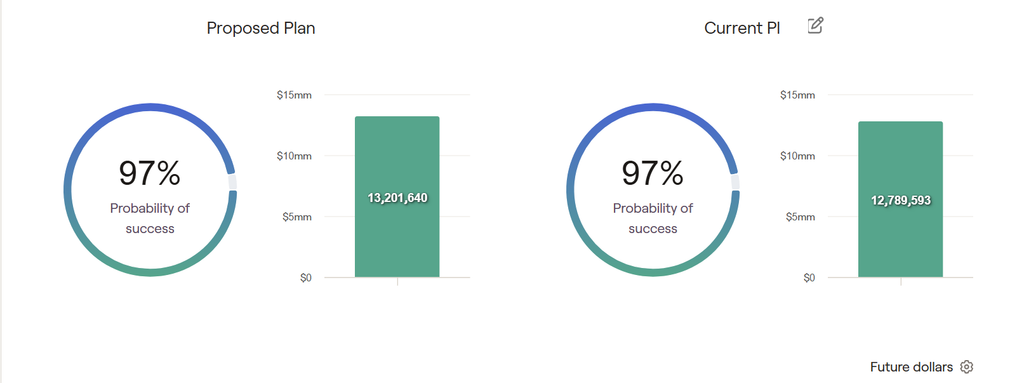
But the amount given to your church is the same in each scenario; it’s just that in our proposed scenario you get to pay less in taxes. Does it add some complication? Yes. Does it commit you to giving? Oh, yes. That’s a feature though, not a bug, and there’s nothing stopping you from giving extra directly to your church or other ministries while this plan is executed.
How to Supercharge the DAF
In our hypothetical the Hills gave cash to the DAF, but the same strategy can have an even bigger impact depending on the assets you have. Next time we’re going to talk about gifts of appreciated securities. Gifts of appreciated stock to a DAF are capped at 30% of AGI compared to 60% for gifts of cash. We’ll talk more in depth about that later.
Right-sizing your gift to the donor-advised fund is about how much you’re already giving, how much you’d like to give, and what the tax benefits associated with it are. Sometimes a mix of cash and appreciated securities makes the most sense in your giving. And pairing a large charitable gift with Roth conversions can really supercharge your retirement tax plan — and that’s a future show I’m excited to get to.
Who This Is Not For
If what you’re giving is simple and steady and your income is fixed and low, then a DAF could very well be just adding complications without any benefit. If you don’t have the cash or securities available to donate, this isn’t going to do much for you, especially with the standard deduction getting so high, and especially for those who are 65+. There’s simply no tax benefit to doing this unless the bunched gift is large enough to push you over the standard deduction and into itemizing.
Heart Check
Getting a deduction is not a reason to give. But active tax planning can help you give more. Over the Hills’ plan, the proposed path projection results in more assets at the end of their lives and sends more to the church than the current one in the end. Remember the sixth year of giving that stayed in the DAF? In this hypothetical the assets are invested — and the leftover balance of around $50,000 after their regular church giving grew and compounded into a large balance over the next 30+ years of their lives that the projection shows as about $766,000 still in the DAF at the end of their lives, all of it eventually ending up at a charity. That’s extra money to give while you’re alive, when you die, or for a successor advisor to request grants to charities from after you’re gone.
Assignment
You can check to see if this may work for you. Are you itemizing or taking the standard deduction? Are you planning to continue giving to your church through your lifetime? Go ahead and calculate what 5 or 10 years’ worth of gifts to your church works out to. What if you gave it all in one year to a DAF and let the DAF give monthly grants to your church? These are some thoughts to take to your tax professional and to think through as you work on your retirement plan. It may mean extra tax savings with the same level of giving. If you’re hesitant to commit to the gift, remember why you’re giving in the first place. Give cheerfully. Give with joy. We’ll see you next time.
Soli Deo Gloria!
Sources
IRS, Revenue Procedure 2025-32 — 2026 standard deduction ($32,200 married filing jointly; additional $1,650 per spouse age 65 or older) and 2026 tax brackets. https://www.irs.gov/pub/irs-drop/rp-25-32.pdf
IRS, IR-2025-103, “IRS releases tax inflation adjustments for tax year 2026, including amendments from the One, Big, Beautiful Bill.” https://www.irs.gov/newsroom/irs-releases-tax-inflation-adjustments-for-tax-year-2026-including-amendments-from-the-one-big-beautiful-bill
Public Law 119-21, the One Big Beautiful Bill Act — Sec. 70103 (deduction for seniors, $6,000 per qualifying individual, tax years 2025–2028), Sec. 70424 (deduction for charitable contributions by non-itemizers, $1,000/$2,000, donor-advised funds excluded), Sec. 70425 (0.5% of adjusted gross income floor on itemized charitable deductions, effective 2026). https://www.congress.gov/bill/119th-congress/house-bill/1/text
IRS Publication 526, Charitable Contributions — adjusted gross income limits for cash gifts (60%) and gifts of appreciated property (30%) to public charities and donor-advised funds. https://www.irs.gov/publications/p526
Luke 14:28 (ESV).
Hank and Peggy Hill are a hypothetical illustration, not clients. Their plan figures were generated with financial planning software using stated assumptions. Projections are not guarantees of future results.
Scripture quotations are from the ESV® Bible (The Holy Bible, English Standard Version®), © 2001 by Crossway. Used by permission. All rights reserved.
This content is for educational purposes only and is not intended as legal, tax, or investment advice. Please consult with a qualified professional for guidance specific to your situation. Investment advisory services offered through Demland Wealth LLC, a state-registered investment advisor in Ohio & Indiana.